Sound familiar?Smithfield
- The call
- Watching from inside as the door opens, you can see the gap between the second and third panels open up on one side as they turn the corner into the ceiling, then close again. The other side stays tight.
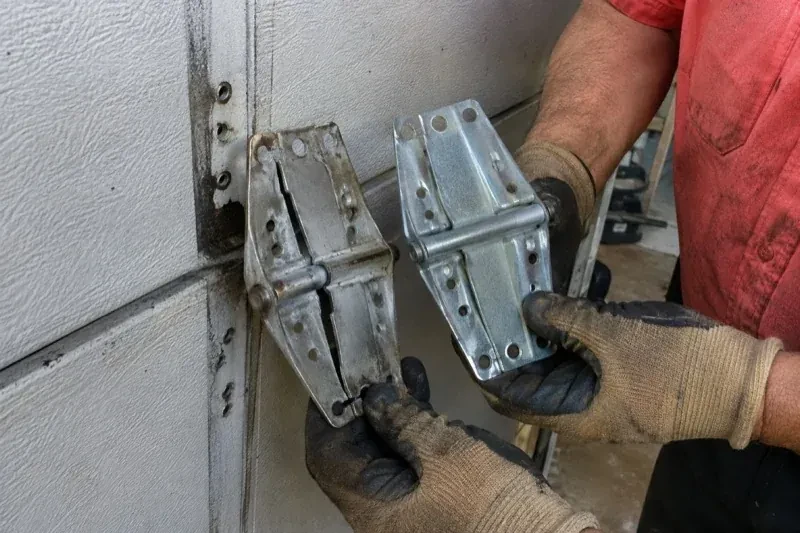
The hinge is only as good as what it is screwed to. On a steel door the screws bite into the stile, a folded steel channel at the panel edge, sometimes with a support plate behind it; on a wood door they thread into timber. Years of vibration back screws out, and once a hole is stripped the hinge rocks and the joint loosens. Hinge replacement includes fresh fasteners, and where holes have opened up the technician shifts to sound metal, steps up to a larger self-drilling screw, or bolts through the panel with a nut and washer or a backer plate. The new hinge then stays put.
Sound familiar?Smithfield
Garage Door Hinge Replacement · Smithfield
Scene 1
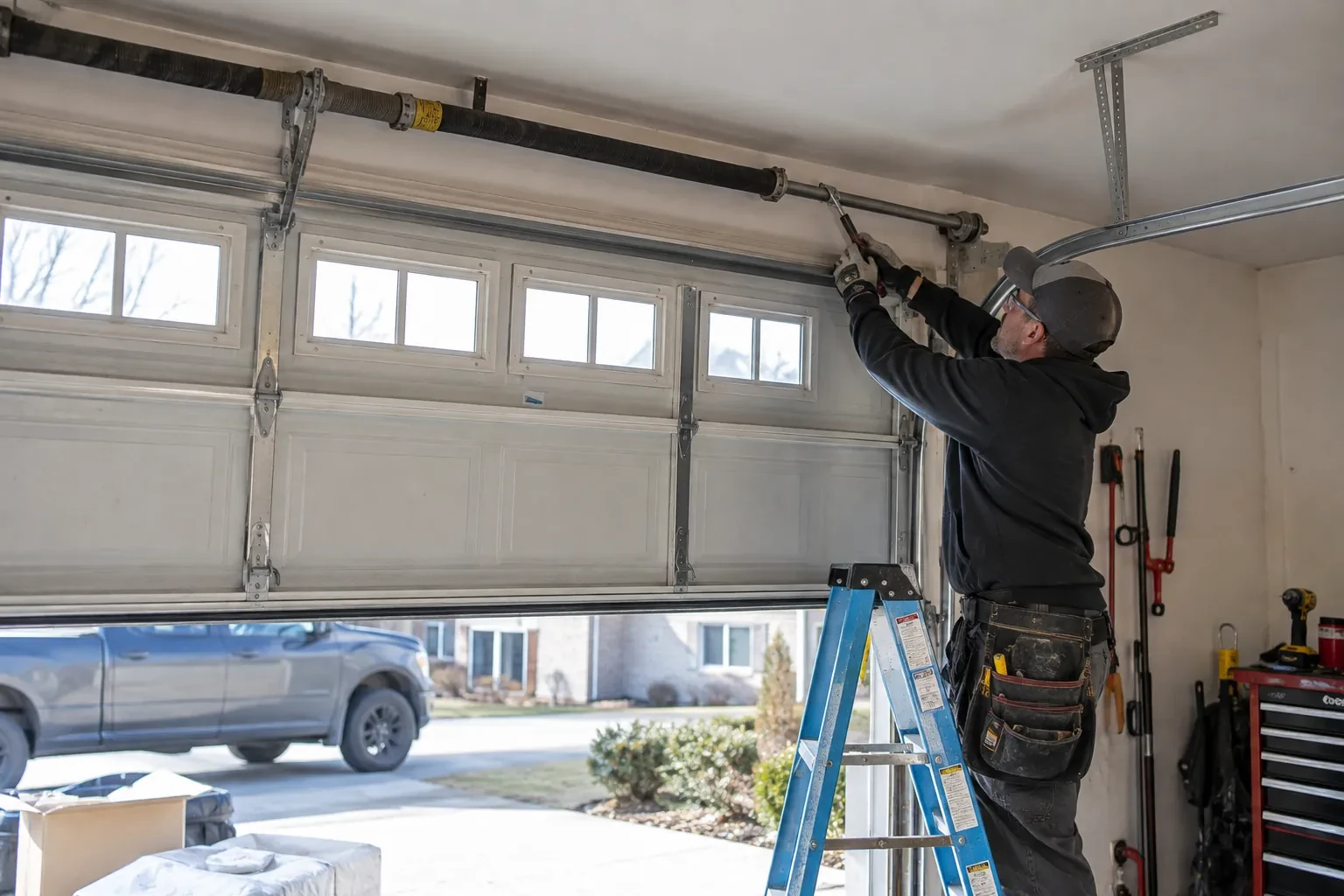
A hinge only holds if its fasteners do. The technician tests each screw for grip and looks at the stile it threads into: the folded steel channel at the panel edge on a steel door, the hinge support plate behind the skin where one is fitted, or the solid timber of a wood door. Holes that have stretched, rusted or torn are noted, because a new hinge on a stripped hole rocks just like the old one. Where the metal is thin or the wood is soft, the plan changes from screws to a through-bolt with a nut and washer, or a backer plate that spreads the load across fresh material.
Scene 2
Where screws spin or a hole has torn, the fix is a better anchor. The technician chooses from three approaches. First, shift the hinge slightly to sound metal within the stile, where the hole pattern allows it. Second, step up to a larger self-drilling screw that bites fresh threads in the existing hole. Third, drill through the panel and fit a bolt with a nut and washer, or a backer plate across the inside of the stile, so the load spreads across fresh material rather than a torn edge. On a wood door, a split stile is filled or reinforced before the hinge goes back on.
Scene 3
A well-hinged door has a sound, a steady rumble with no clicks, and it is worth getting to know it. A new pop or click at a fixed height points at a hinge or roller at that joint. A grinding note from one end suggests a roller bearing. A rattle when the door settles onto the floor is often a loose centre hinge screw. Because you now know what the door sounds like when everything is tight, a change stands out early, while it is a screw or a single hinge rather than a bent panel. A phone recording of the healthy door is a handy reference.
What shapes the quoteRice Lake Garage Door Repair Co.
FeesSame any hour
Often noticeably. A cracked or loose hinge is the source of many pops, clicks and rattles, and a hinge that holds its roller square lets the wheel run flat instead of scraping the track lip. Combined with fresh lubricant on the knuckles and rollers, the door settles into a steady rumble. Any noise that remains usually points to the rollers, the opener chain or the springs, which the technician can identify for you.
Edge hinges belong to their own joint. Put a 3 where a 2 belongs and the roller sits at the wrong reach, so the door binds, gaps at the curve or fails to press against the jamb when closed. Centre hinges are the exception, since they all share the geometry of a 1. The technician reads the stamp on the old hinge or counts the joint from the floor before choosing the part.
Steel flexed often enough eventually cracks, and several things speed that up. A door out of balance is dragged by the opener, and every hinge takes the strain. A seized roller twists its hinge on each trip. A track out of line pinches the panels at the curve. A wide panel without a strut flexes at the joint. Corrosion at the low hinges thins the steel. The technician looks for which of these was at work so the new hinge is spared the same stress.
NorthumberlandOntario
Garage Door Hinge Replacement · Cobourg, Alnwick/Haldimand, Brighton, Cramahe, Hamilton, Gosport, East Colborne, Coverdale, Norham, Codrington, Orland
Every square is one home in a hundred.
On-site assessment preferred · (289) 677-1944, open 24/7